
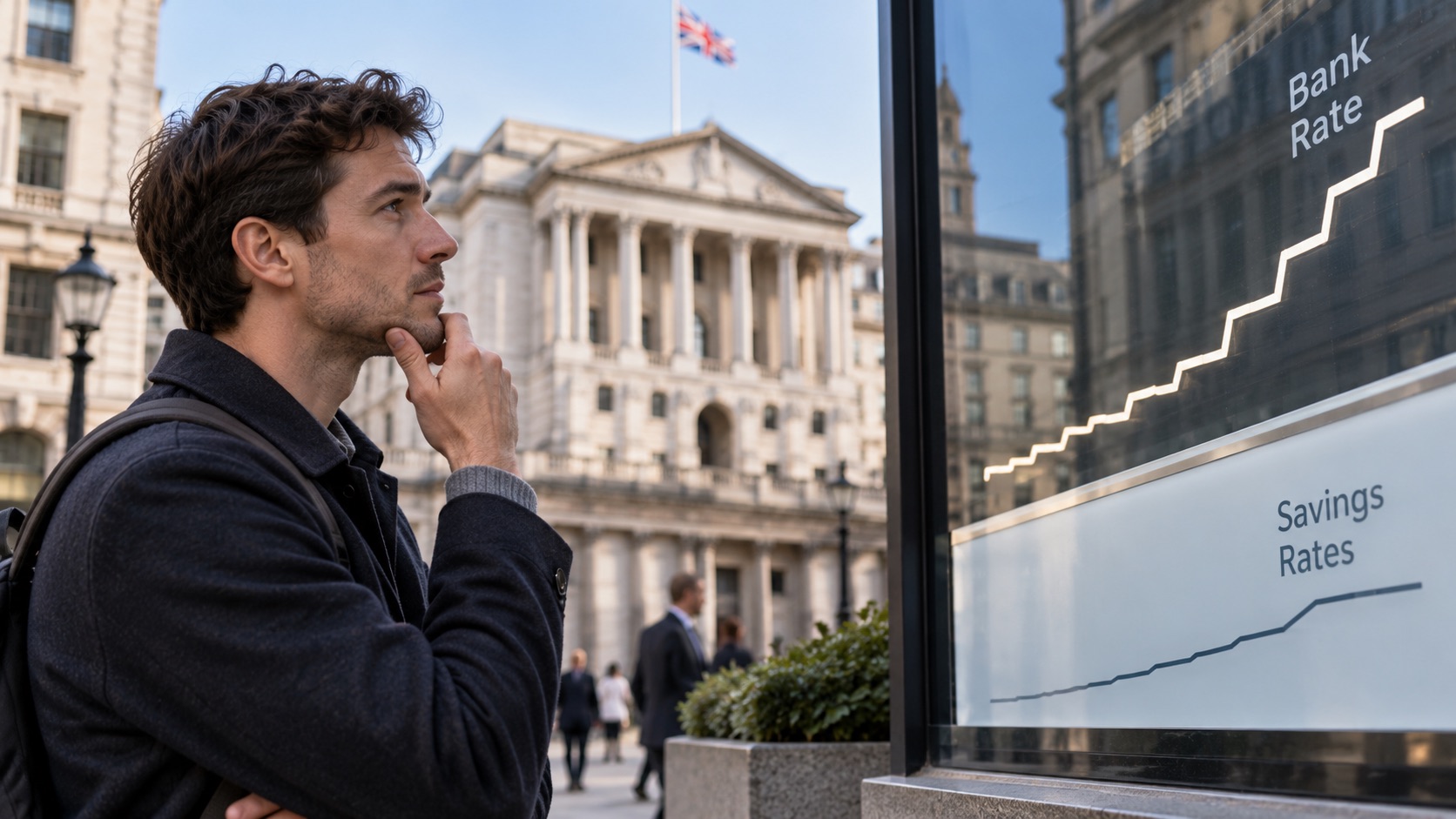
When the Bank of England started raising interest rates in late 2021, borrowers quickly became familiar with the consequences. Mortgage rates increased, loans became more expensive and the cost of borrowing rose.
For savers, higher interest rates should also have brought a benefit: better returns on money held in savings accounts.
Savings rates did rise. But they did not all rise at the same speed.
Calfiny analysed 67 months of Bank of England savings data, covering January 2021 to July 2026. The data shows that as interest rates increased, a sizeable gap opened between the rates being advertised on instant-access savings accounts and the rate reflected across the much larger pool of money households already held in accessible interest-paying deposits.
The gap was almost nonexistent at the beginning of 2022. By December 2023, it had widened to 0.81 percentage points.
Put simply, better savings rates were appearing in the market, but the return reflected across money already sitting in accessible household deposits was not keeping pace.
As interest rates rose, how quickly did better savings rates feed through to money UK households already held in accessible interest-paying deposits?
Calfiny analysed 67 months of Bank of England data covering January 2021 to July 2026.
Based on approximately £855bn held in accessible interest-paying household deposits. This is not an estimate of money actually lost by savers.
What happened when the Bank of England raised interest rates?
Bank Rate is the interest rate set by the Bank of England. It influences interest rates throughout the economy, including the rates banks charge borrowers and the rates they pay savers.
But the Bank of England does not tell banks and building societies exactly what rate they must pay on savings accounts.
When Bank Rate changes, each savings provider decides how much of that change to pass on to its customers. Competition, the amount of money a bank needs to attract from savers and its wider funding position can all influence that decision.
As Bank Rate increased rapidly from late 2021, savings rates increased too. The important point is that much of the instant-access savings market did not initially keep pace.
The Bank of England itself highlighted this in May 2023. Bank Rate had increased by 4.15 percentage points since November 2021, while its average quoted instant-access savings rate had increased by around 1.4 percentage points. The Bank described the passing-on of higher rates to instant-access savings accounts as unusually weak.
The Bank suggested several reasons for this. One was that banks already had a plentiful supply of customer deposits, which reduced the need to compete aggressively for additional savings. Another was that the gap between Bank Rate and savings rates had become unusually small during the long period when Bank Rate was close to zero, so some widening of that gap was expected as rates returned to more normal levels.
The FCA found that savers received only part of the increase
Evidence from the Financial Conduct Authority makes the issue particularly clear.
The FCA examined nine of the UK’s largest savings providers after concerns about how quickly higher interest rates were reaching savers.
Between January 2022 and May 2023, these providers had passed on an average of just 28% of the increase in Bank Rate to their easy-access savings accounts.
Fixed-rate savings accounts and notice accounts responded more strongly, with the same providers passing on 51% of the Bank Rate increase over that period.
The FCA also found substantial differences between savings providers, with smaller firms generally paying higher rates than larger providers.
This does not mean banks were required to match every Bank Rate increase. They were not. But it does show that rising Bank Rate did not automatically result in an equivalent increase in the interest being paid to easy-access savers.
Better savings rates were appearing elsewhere
While rates on many existing savings balances were increasing relatively slowly, more competitive savings rates were appearing in the market.
This created an important difference between the rate a saver might see advertised and the return being reflected across the much larger amount of money households already had sitting in accessible interest-paying deposits.
That difference is what Calfiny’s research investigates.
For the analysis, we compared two Bank of England measures.
The first tracks rates being quoted on qualifying instant-access savings accounts. It is not a list of the very best savings accounts available, but it provides a consistent measure of advertised instant-access savings rates over time.
The second reflects the rate across the wider pool of household deposits that pay interest and can broadly be accessed without giving advance notice.
The Bank of England calls these interest-bearing sight deposits. We use that technical term in the methodology later in this article, but for understanding the research it is easiest to think of them as the wider pool of accessible household deposits already earning interest.
Comparing the two allows us to ask a straightforward question:
As better instant-access rates appeared in the market, how closely did the return across existing accessible household deposits keep up?
The gap became much wider as interest rates rose
At the beginning of 2022, there was practically no difference.
In January 2022, the Bank of England’s quoted instant-access rate was 0.11%, while the rate across the wider pool of accessible interest-paying household deposits was 0.10%.
The difference was just 0.01 percentage points.
As interest rates increased, that changed.
By December 2022, the quoted instant-access rate had reached 1.20%, compared with 0.80% across the wider pool of existing accessible deposits. The gap had grown to 0.40 percentage points.
It widened further during 2023.
The largest gap appeared in December 2023
December 2023 produced the largest difference found anywhere in the 67 months analysed.
The Bank of England’s quoted instant-access savings rate was 2.81%.
The rate across the wider pool of existing accessible interest-paying household deposits was 2.00%.
That left a gap of 0.81 percentage points.
The savings rate gap at its widest
The largest difference identified across the 67 months analysed.
| Measure | Result |
|---|---|
| Accessible interest-paying household deposits | £855.117bn |
| Rate across those household deposits | 2.00% |
| Quoted instant-access savings rate | 2.81% |
| Difference between the two rates | 0.81 percentage points |
| Illustrative annual value of the difference | Approximately £6.93bn |
The £6.93bn figure shows the scale of the rate difference. It is not an estimate of interest actually lost by UK savers.
Source: Calfiny analysis of Bank of England series LPMZ3TH, LPMZ3U7 and IUMB6VJ.
In everyday terms, the data shows that the rates being advertised on instant-access savings accounts had moved noticeably ahead of the rate reflected across the much larger amount of money households already held in accessible interest-paying deposits.
There was also a very large amount of money involved.
UK households held approximately £855 billion in these accessible interest-paying deposits in December 2023.
That allows us to illustrate the financial scale of a 0.81 percentage-point difference.
Does that mean savers lost £6.9 billion?
No.
The £6.9 billion figure is there to show how financially significant a seemingly small difference in interest rates can become when it is applied to hundreds of billions of pounds.
It would be misleading to say that banks withheld £6.9 billion from savers or that savers definitely lost that amount.
The two Bank of England datasets measure different things. The quoted rate represents rates being advertised on qualifying instant-access savings products, while the other rate reflects the much broader pool of existing accessible household deposits.
Not every saver could necessarily have moved every pound into an account paying the quoted rate. Individual accounts also had different rates, terms and eligibility requirements.
The calculation therefore illustrates the scale of the rate gap. It does not calculate money actually lost by individual savers.
This wasn’t just a one-month difference
December 2023 was the peak, but the wider pattern is more important than any single month.
The gap had grown from virtually nothing in early 2022, became much wider during 2022 and 2023, and then remained visible after its December 2023 peak.
By December 2024, the quoted instant-access rate was 2.59%, compared with 2.20% across the wider pool of accessible household deposits. The difference had fallen to 0.39 percentage points.
By December 2025 it was 0.50 percentage points.
In July 2026, the final month in our analysis, the quoted instant-access rate was 2.09%, while the rate across the wider pool of existing accessible household deposits was 1.60%.
That left a difference of 0.49 percentage points.
Put simply, the gap had become smaller than at its December 2023 peak, but better rates were still being quoted on instant-access savings products than the rate reflected across the money households already held in the wider pool of accessible interest-paying deposits.
How the savings rate gap changed
Selected months show how the difference grew and then narrowed during the period analysed.
| Selected month | Rate across existing accessible deposits | Quoted instant-access rate | Difference |
|---|---|---|---|
| January 2022 | 0.10% | 0.11% | 0.01pp |
| December 2022 | 0.80% | 1.20% | 0.40pp |
| December 2023 | 2.00% | 2.81% | 0.81pp |
| December 2024 | 2.20% | 2.59% | 0.39pp |
| December 2025 | 1.70% | 2.20% | 0.50pp |
| July 2026 | 1.60% | 2.09% | 0.49pp |
December 2023 was the largest monthly difference identified across the 67 observations.
Source: Calfiny analysis of Bank of England series LPMZ3U7 and IUMB6VJ.
Why didn’t banks simply pass on the full increase?
There isn’t one simple explanation.
Higher Bank Rate does not require a bank or building society to increase its savings rates by the same amount.
Banks use customer deposits as one source of funding. If a bank already has more than enough deposits to support its lending and other activities, it may have less commercial reason to offer significantly higher rates simply to attract additional savings.
The Bank of England identified this as one possible explanation during the rising-rate period. It said the banking sector had an ample supply of deposit funding, which may have reduced the incentive for banks to increase rates to attract more deposits.
Competition matters too.
A provider that wants to attract new savings may offer a more competitive rate. Another provider with a large amount of money already sitting in existing accounts may face less immediate pressure to do so.
This helps explain how higher rates can appear in the savings market without every existing saver automatically receiving them.
There was another factor. During the years when Bank Rate was close to zero, banks had limited room to reduce ordinary savings rates much further without paying no interest at all or introducing negative rates. The Bank of England has explained that this compressed the normal difference between Bank Rate and savings rates. Some widening of that difference was therefore expected when Bank Rate began rising again.
None of this establishes wrongdoing. It does, however, help explain why a Bank Rate increase should not be interpreted as an automatic equivalent increase in the rate paid on a savings account.
The FCA intervened as concerns grew
By the middle of 2023, the difference between rising Bank Rate and the rates received by many savers had attracted regulatory attention.
In July 2023, the FCA introduced a 14-point action plan for the cash savings market. Its aim included ensuring that banks and building societies were passing interest-rate increases to savers appropriately, communicating more effectively with customers and offering better savings deals.
The regulator also focused on the difference between accounts providers were actively selling to new customers and older accounts that were no longer on sale.
There were signs that the market subsequently became more competitive.
FCA figures show that the average easy-access rate across the firms it monitored increased from 1.66% in July 2023 to 2.11% by June 2024.
The FCA estimated that savers were receiving around £4 billion more interest each year as a result of higher savings rates.
It also found evidence that people were moving their money. Between July 2023 and October 2023, deposits in easy-access and non-interest-bearing accounts fell by £11 billion, while money in fixed-term and notice accounts increased by £17 billion.
This suggests that the story is not simply that savings providers never responded to higher rates. Rates did improve, competition increased and some savers moved money towards better-paying accounts.
But those improvements took time, and the largest firms continued to pay below-average rates on some easy-access products even after the market had become more competitive.
So what does Calfiny’s research actually show?
The clearest conclusion is that higher interest rates did not feed through evenly across the savings market.
As Bank Rate rose, better savings rates became available. But the rate reflected across the large amount of money households already held in accessible interest-paying deposits increased more slowly.
Calfiny’s analysis shows how the difference developed.
It was just 0.01 percentage points in January 2022, widened to 0.40 percentage points by December 2022 and reached 0.81 percentage points in December 2023.
Independent evidence from both the Bank of England and FCA supports the broader picture. The Bank of England described the passing-on of higher rates to instant-access savers as unusually weak during the rising-rate cycle, while the FCA found that nine large providers had passed on only 28% of the Bank Rate increase to easy-access deposits between January 2022 and May 2023.
What the research does not show is that banks acted unlawfully, deliberately withheld a particular amount of interest or were required to match Bank Rate.
Instead, it demonstrates something much more practical: a rise in Bank Rate does not mean the interest rate on your existing savings account will rise by the same amount.
During the recent interest-rate cycle, the difference between rates appearing in the instant-access savings market and the rate reflected across existing accessible household deposits became substantial.
For savers, that distinction mattered.
Research transparency Sources, Limitations & Methodology See how this research was carried out, what data was used and what the findings cannot tell us.
Methodology
Calfiny analysed 67 months of Bank of England data covering January 2021 to July 2026. For each month, we compared the Bank’s measure of rates being quoted on instant-access savings accounts with its measure of the rate across the wider pool of accessible household deposits already earning interest. We then measured how the difference between those rates changed over time. Where we show the value of that difference in pounds, we applied the percentage-point gap to the amount households held in accessible interest-paying deposits at that point. The analysis used Bank of England series LPMZ3TH, LPMZ3U7 and IUMB6VJ.
Limitations
The two Bank of England rate measures are not two savings accounts that every saver could simply choose between. The quoted instant-access rate measures advertised rates on qualifying products, while the other measure covers a much broader pool of existing household deposits. This means the calculations can show the financial scale of the gap but cannot tell us exactly how much individual savers could have earned by moving their money. Around £40 billion was reclassified from interest-bearing to non-interest-bearing deposits in October 2022, with a further approximately £18 billion reclassified in June 2023 following a change in one institution’s terms and conditions. These are statistical reclassifications and should not be interpreted as households moving those amounts between savings accounts. Calfiny therefore does not describe the £6.9 billion figure as money lost by savers or add the monthly figures together to produce a cumulative loss estimate.
Sources
- Bank of England — Household interest-bearing sight deposits (LPMZ3TH)
- Bank of England — Household sight-deposit rate (LPMZ3U7)
- Bank of England — Quoted instant-access deposit rate including unconditional bonuses (IUMB6VJ)
- FCA — Cash Savings Action Plan, July 2023
- FCA — Cash Savings Update, September 2024