

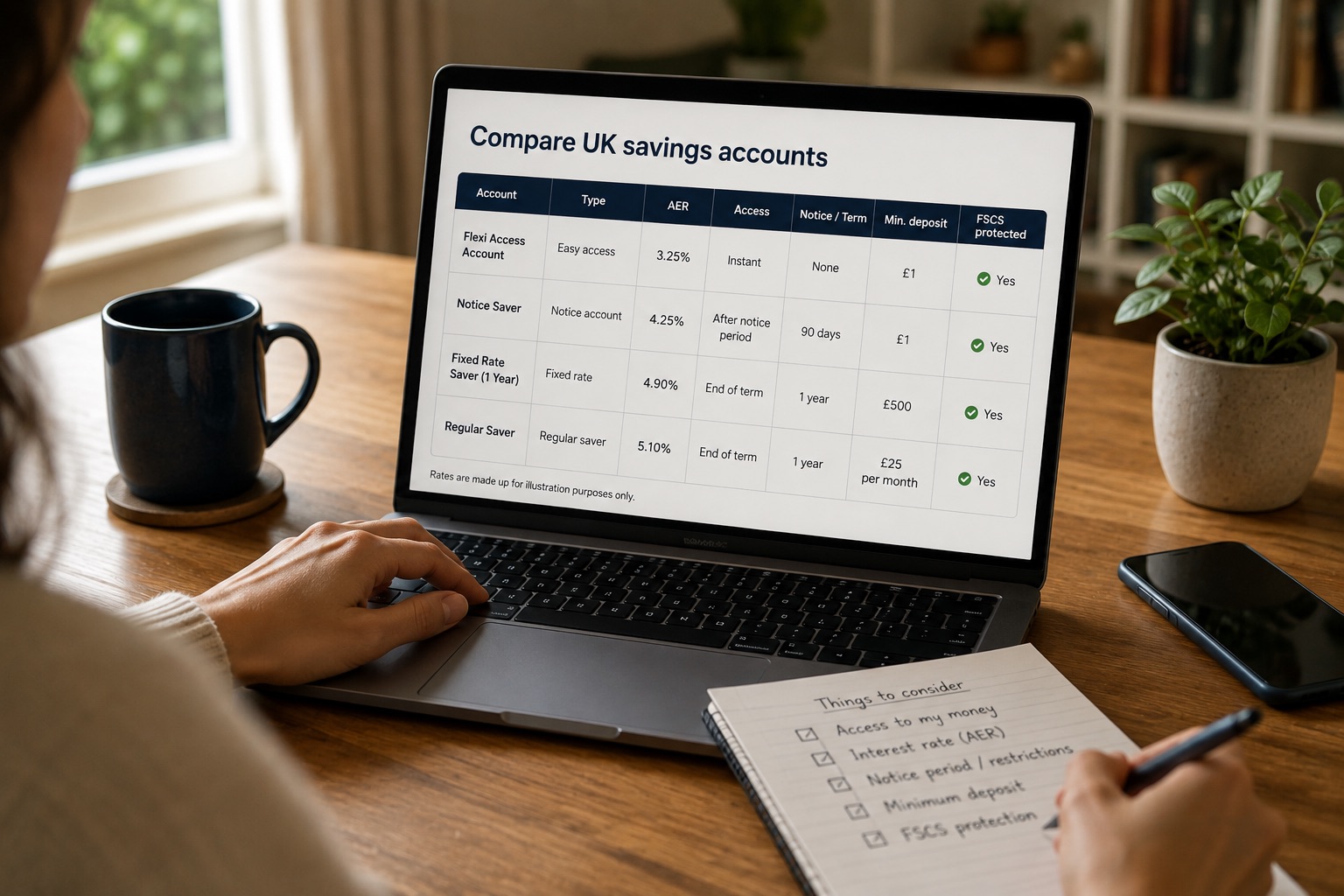
What Should You Look for in a Savings Account?
Once you have money set aside, the next question is where to keep it.
In the UK, there are several types of savings account. They can differ in how easily you can withdraw your money, how interest is paid, whether the interest rate can change, how much you can deposit and what conditions you need to meet.
That means choosing a savings account is not simply a matter of finding the highest advertised interest rate.
A higher rate may come with restrictions that do not fit the way you need to use the money. Equally, accepting a lower rate in return for greater flexibility may or may not be worthwhile depending on the purpose of the savings.
A useful starting point is therefore to ask:
What does this money need to do?
Consider when you might need it, how quickly you would need access, whether you are adding money regularly or depositing an existing lump sum and how much flexibility you are prepared to give up.
Once those requirements are clearer, the differences between savings accounts become much more meaningful.
Start With What the Savings Are For
Two people can have exactly the same amount saved but need very different things from their accounts.
Money forming part of an emergency fund may need to be available at relatively short notice because you cannot predict when an unexpected expense will appear.
Money for a planned expense in 12 months has a different job. If you are confident it will not be needed before then, you may have more flexibility over the access conditions you are prepared to accept.
£5,000 for Unexpected Costs
If the £5,000 forms part of an emergency fund, being able to access it when an unexpected expense occurs may be particularly important. Restrictions that delay or limit withdrawals could therefore matter considerably.
£5,000 for a Planned Expense
If the £5,000 is intended for an expense in around 12 months and you are confident it will not be needed earlier, you may be more comfortable considering accounts with greater access restrictions.
The balances are identical, but the money has a different job. That can change which account features matter most.
How you are building the savings can matter too.
Someone depositing an existing £10,000 lump sum may have different priorities from someone adding £200 from their income each month.
The purpose, timeframe and way the money is being saved can therefore help you narrow down which account features are relevant before you start comparing individual products.
If you are building towards a specific target, How to Save for a Financial Goal explains how to connect the amount you need, your contribution and the timeframe.
What Matters When You Compare Savings Accounts?
Savings accounts can have many different terms, but four areas provide a useful starting framework.
Four Features to Compare
Consider these features together rather than choosing an account because one of them looks particularly attractive.
Access
Check how quickly you can withdraw your money and whether there are notice periods, withdrawal limits or other restrictions. The importance of access depends partly on when you may need the savings.
Interest rate
Check the AER being offered and whether the rate is fixed for a period or variable and therefore able to change.
Restrictions and conditions
Look for minimum or maximum deposits, contribution limits, eligibility requirements, withdrawal conditions and any other rules that could affect how you use the account.
How you intend to save
Consider whether you have an existing lump sum, expect to add money regularly or want the flexibility to do both. Different accounts are designed around different saving patterns.
None of these features should necessarily be considered in isolation.
An account could offer an attractive interest rate but restrict access in a way that makes it unsuitable for money you may need unexpectedly.
Another account could provide considerable flexibility but offer a lower rate than alternatives with tighter conditions.
The useful comparison is therefore between accounts that can actually perform the job you need your savings to do.
What Are the Main Types of UK Savings Account?
Savings providers offer many individual products, but most everyday savings accounts fall into a small number of broad categories.
Understanding how these categories work can make it easier to decide which products are worth comparing in more detail.
Easy-access savings accounts
Easy-access savings accounts are designed to provide relatively flexible access to your money while allowing the balance to earn interest.
That flexibility can be useful for savings you might need without much warning.
Emergency savings are an obvious example. If the purpose of the money is to help deal with an unexpected financial problem, being able to access it can be particularly important.
But the term easy access does not mean every account works identically.
Providers can have different withdrawal arrangements, minimum balances and account conditions. Some products described as easy access may limit the number of withdrawals or attach conditions to them.
The interest rate is also commonly variable, which means it can change.
You should therefore still check the individual account terms rather than assuming that every easy-access account provides unrestricted access on identical conditions.
The main advantage is flexibility. The trade-off is that other types of savings account may sometimes offer different rates in return for accepting greater restrictions.
Fixed-rate savings accounts
Fixed-rate savings accounts generally pay a set interest rate for an agreed period.
The term might last several months or several years depending on the account.
Knowing the rate for that period can provide greater certainty about the interest rate your savings will receive, provided the account conditions are met.
The trade-off is usually access.
Your money may need to remain in the account for the agreed term. Some accounts do not permit early withdrawals, while others may allow them only in particular circumstances or subject to conditions or penalties.
This makes your timeframe important.
If you are confident that you will not need the money until the fixed period ends, accepting restricted access may be easier.
If there is a realistic possibility that you will need the savings earlier, the restriction could become much more significant.
You should also check what happens at the end of the fixed term.
The account may mature into another product or different arrangements may apply, including a different interest rate. Reviewing the options as maturity approaches can help you decide what you want the money to do next.
If you are deciding between these two broad approaches, Easy-Access vs Fixed-Rate Savings Accounts explores the trade-off between flexibility and fixing your rate in more detail.
Notice savings accounts
Notice savings accounts provide another approach to access.
Rather than allowing relatively free withdrawals or locking your money away until a fixed maturity date, they generally require you to give the provider advance notice before withdrawing.
The notice period varies between accounts.
For example, an account might require you to request a withdrawal a set number of days before you want the money.
This can provide more flexibility than committing your savings to a fixed term, but it may not work well for money you could need immediately.
Providers can also have different rules about deposits, withdrawals and what happens if you need access without giving the required notice.
The advertised interest rate therefore needs to be considered alongside those conditions.
What Is a Notice Savings Account? explains how notice periods and withdrawals work in more detail.
Regular saver accounts
Regular saver accounts are designed primarily for people building savings gradually.
Rather than depositing a large existing balance, you typically add money regularly, often each month.
These accounts can sometimes advertise attractive interest rates, but their contribution and withdrawal rules can be more restrictive than those of some other savings accounts.
For example, there may be:
- minimum or maximum monthly contributions;
- limits on withdrawals;
- requirements around regular deposits; or
- eligibility conditions, such as holding another account with the provider.
The way the advertised interest rate applies also needs to be understood.
If you contribute £200 each month for 12 months, you will have deposited £2,400 by the end of the year.
But the entire £2,400 has not been in the account for the full 12 months.
The first £200 has had much longer to earn interest than the final £200 deposited near the end of the period.
This distinction can be important when comparing a regular saver with an account into which you deposit a lump sum at the beginning.
What Is a Regular Saver Account? explains these accounts in more detail.
Once you understand the four broad types, it becomes easier to see how their characteristics differ.
Individual products vary, so always check the actual account terms. This comparison shows the broad characteristics of the main account types. Designed to provide relatively flexible withdrawals; rates are commonly variable. Greater flexibility, although account-specific withdrawal conditions can still apply. Rate normally fixed for an agreed term, with access generally more restricted. Greater rate certainty in return for accepting less flexibility. Withdrawals normally require advance notice rather than waiting for a fixed maturity date. Some access flexibility remains, but the money may not be available immediately. Designed around regular contributions, often with monthly deposit rules or limits. Can suit gradual saving, but contribution and withdrawal conditions may restrict how the account is used. The account types solve different problems. The useful starting point is the type whose access, rate structure and deposit rules best fit the way you intend to use the savings.UK Savings Account Types at a Glance
Easy access
Fixed rate
Notice
Regular saver
These descriptions are general.
Individual providers can structure products differently, so the name of the account should never replace checking its actual terms and conditions.
How Do Fixed and Variable Savings Rates Differ?
The type of savings account and the type of interest rate are related, but they are not the same thing.
A fixed interest rate is normally set for an agreed period, subject to the account terms.
This gives you greater certainty about the rate that will apply during that period.
A variable interest rate can change while you hold the account. The provider may increase or reduce it in accordance with the account terms and applicable requirements.
Easy-access savings accounts commonly use variable rates, while fixed-term accounts commonly use fixed rates, although you should always check the particular product rather than relying on the account name.
Fixed vs Variable Interest Rates explains the distinction in more detail.
When comparing savings rates, you will also commonly see AER, or Annual Equivalent Rate.
AER is designed to make savings rates easier to compare on an annual basis by taking account of the effect of compounding and assuming the money remains in the account under the relevant conditions.
It can help you compare rates, but it does not tell you whether the account’s access rules or other conditions suit your savings.
Our AER vs APR Explained guide explains what AER measures and how it differs from APR.
Is the Highest Savings Rate Always Best?
Not necessarily.
The interest rate matters because it affects the return your savings can earn.
But it is only useful if the account itself works for the money you are putting into it.
Suppose one account offers a higher rate but requires you to leave the money untouched for a fixed period.
Another account offers a lower rate but allows much easier access.
If the money is part of an emergency fund, the ability to withdraw it when an unexpected expense occurs may be more important than the difference between the two rates.
If you are confident the money will not be required during the restricted period, the trade-off may look different.
Deposit rules can create similar differences.
A regular saver with an attractive rate may be useful if the amount you want to contribute fits within its monthly limits. It may be much less relevant if you already have a large lump sum that you want to deposit immediately.
The better sequence is therefore:
Identify the account features the money requires first.
Then:
Compare the rates and terms among accounts that meet those requirements.
This does not mean treating the interest rate as unimportant.
Once you have narrowed the choice to accounts that provide the access, deposit arrangements and other features you need, the rate can become an important part of comparing those options.
How to Compare Savings Accounts Properly takes that product-comparison process further.
How Safe Are UK Savings Accounts?
Account features and interest rates are not the only things worth checking. You should also understand who holds the money and what deposit protection applies.
Eligible deposits held with UK-authorised banks, building societies and credit unions can currently be protected by the Financial Services Compensation Scheme (FSCS) if the authorised firm fails.
The current deposit protection limit is £120,000 per eligible person, per authorised firm. The limit increased from £85,000 to £120,000 on 1 December 2025.
The words per authorised firm are important.
Different banking brands can sometimes operate under the same banking licence. If they do, eligible money held across those brands can count towards the same protection limit rather than each brand automatically having its own separate £120,000 allowance.
For example, simply splitting savings between two different brand names does not necessarily mean the money sits with two separately authorised firms.
FSCS eligibility and the authorisation behind the particular account should therefore be checked rather than assumed.
There are additional rules for some circumstances, including certain qualifying temporary high balances, but those are beyond the purpose of this introductory account guide.
How Safe Are UK Savings Accounts? explains FSCS protection, banking licences and the other considerations in more detail.
How Can You Match an Account to Your Savings?
Once you understand the account types, the final step is to bring the features back to the job your money needs to do.
You do not necessarily need one account to perform every savings role.
Money that may be needed unexpectedly can have different requirements from money for a planned expense several years away. Savings you are gradually building from monthly income can also have different requirements from an existing lump sum.
This can also mean using more than one account.
You might decide that money requiring immediate accessibility belongs somewhere different from savings that you are confident will not be needed for a set period.
That does not mean everybody needs several savings accounts. It simply means different pots of money do not automatically have to accept the same trade-offs.
If you are deciding where to hold money specifically intended for unexpected expenses, Where Should You Keep Your Emergency Fund? focuses on the requirements of emergency savings.
If the money is for a known target, How to Choose a Savings Account for Your Goal looks more closely at matching account features to the purpose and timeframe.
And once you know the type of account and features you need, How to Compare Savings Accounts Properly explains what to check when comparing individual products.
Conclusion
UK savings accounts can differ substantially even though they all provide somewhere to keep cash and potentially earn interest.
Easy-access accounts generally prioritise flexibility. Fixed-rate accounts can provide greater certainty about the rate in return for accepting restrictions. Notice accounts require advance planning before withdrawals, while regular saver accounts are designed around building savings gradually.
The account type is only the beginning of the comparison.
You should also consider the interest rate, whether it is fixed or variable, withdrawal and deposit rules, other account conditions and the protection that applies to eligible deposits.
The highest advertised rate is therefore not automatically the best place for every pot of savings.
A more useful starting point is to ask what the money needs to do.
Once you know when you may need it, how accessible it needs to be and how you intend to add to it, you can compare accounts whose features actually fit that purpose.


