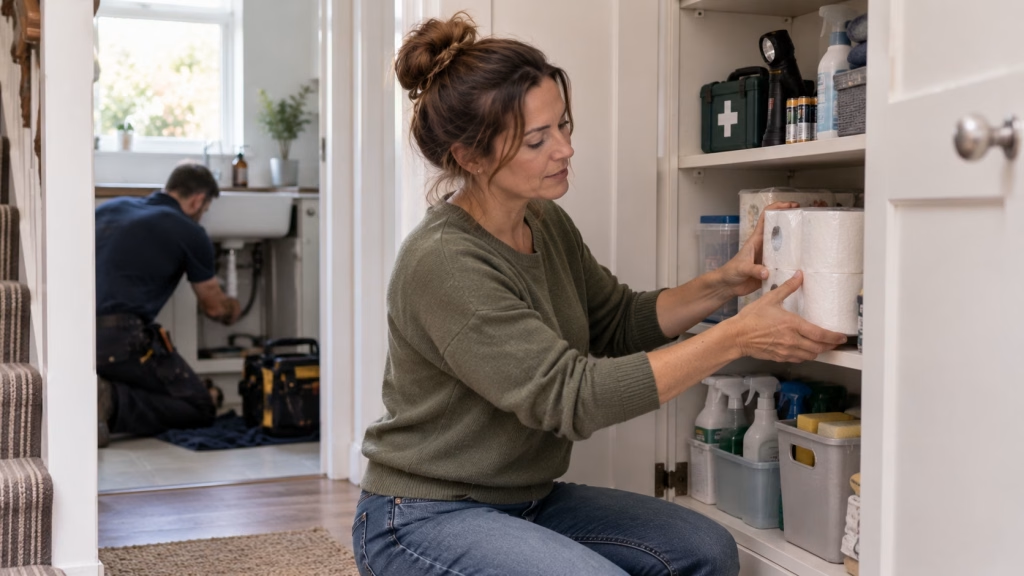


Owning a Home Adds Another Type of Financial Risk
Homeowners face many of the same financial emergencies as everyone else. You could lose your income, face an essential car repair or suddenly need to pay for another unavoidable expense. But owning a property can add a further category of risk because you are also responsible for many of the costs of maintaining the home itself.
A broken boiler, serious leak or urgent electrical problem may need to be dealt with quickly. That can create an expense that a tenant might sometimes expect a landlord to deal with, depending on the circumstances.
This does not mean every homeowner automatically needs a much larger emergency fund. The more useful question is whether your existing cash reserves are large enough to cope with both ordinary financial shocks and the additional costs that homeownership could create.
How Much Emergency Savings Should You Have? explains the general process of deciding how much emergency cash to keep. For homeowners, the extra step is deciding which property costs genuinely belong within that protection.
Separate Genuine Home Emergencies From Normal Maintenance
One of the easiest mistakes to make is treating every expensive home repair as an emergency. Some costs are genuinely unexpected and urgent, while others are a normal part of owning a property even if you do not know the exact date they will arise.
A boiler that suddenly stops working during winter could create an immediate problem. By contrast, an ageing boiler that you know is approaching the end of its useful life is a foreseeable future expense. Likewise, a survey that identifies roof work likely to be needed within the next year has given you advance warning, even if the eventual bill is substantial.
The way you save for a property expense should depend on the nature of the cost, not simply on how large the bill might be.
A boiler suddenly fails during winter and needs dealing with quickly. The timing was not reasonably predictable and delaying the repair may not be practical.
An ageing boiler is still working, but you know it will eventually need replacing. The exact timing is uncertain, but the expense itself is foreseeable.
A survey identifies roof work that should be completed next year. You have a known future expense and time to prepare for it.
A large home expense is not automatically an emergency. Separating unexpected shocks from foreseeable maintenance can help you decide which savings pot should cover it.
Not every home cost is an emergency
Urgent and unexpected
Possible emergency
Irregular but foreseeable
Plan ahead
Known and planned
Specific savings goal
The broader test is whether the expense is necessary, difficult to postpone and genuinely outside what you could reasonably have planned for. What Counts as an Emergency Expense? looks at that distinction in more detail.
Your Emergency Fund and Home-Maintenance Savings Have Different Jobs
For many homeowners, it can be useful to think about emergency savings and home-maintenance savings separately.
An emergency fund is designed to help when something financially disruptive happens unexpectedly. A separate home-maintenance fund can prepare for property costs that are likely to arise eventually but do not happen neatly every month.
For example, decorating, routine servicing and replacing an appliance that is clearly approaching the end of its life are not necessarily emergencies. You may not know exactly when the money will be needed, but you can reasonably expect that homeownership will involve maintenance and replacement costs over time.
A sinking fund can be one way of gradually putting money aside for those irregular but foreseeable expenses. Emergency Fund vs Sinking Fund: What’s the Difference? explains the wider distinction between the two.
Separating the purposes can also make your emergency position easier to understand. If all your savings sit in one account, a balance of £8,000 may look like an £8,000 emergency fund even though £3,000 is effectively reserved for a roof repair you already know is coming.
Think About the Property You Actually Own
Homeownership itself does not tell you how much property-related risk you face. The age, condition and type of home can make a substantial difference.
A recently built property with a newer heating system, roof and electrical installation may present different near-term maintenance risks from an older property where several major components are already approaching the point at which repairs or replacement are likely.
That does not mean an older home automatically requires a huge emergency fund. It means the condition of the actual property should be considered rather than applying the same extra savings amount to every homeowner.
What can change a homeowner's cash-buffer needs?
The amount of additional protection you may want depends on the risks and commitments attached to your own home and household.
Property age and condition
Older or poorly maintained parts of a property may create a greater chance of significant repair costs than recently replaced or well-maintained components.
Essential monthly costs
Your emergency fund may also need to cover normal household expenses if income falls, so the amount you need depends partly on what those essential costs are.
Mortgage commitments
A mortgage payment can represent a substantial essential monthly outgoing that may need to continue during an income interruption.
Known maintenance requirements
Repairs you already know about are better treated as planned costs rather than being silently included in the emergency fund.
Insurance protection
Some events may be insured, while others may fall outside your policy or still require you to pay an excess.
Household income resilience
The effect of an unexpected home cost can be different in a household with several reliable incomes compared with one relying mainly on a single income.
The purpose of considering these factors is not to calculate an exact homeowner premium to add to your emergency fund. It is to identify where your own financial exposure is greater or smaller than a generic emergency-fund rule might suggest.
Insurance Can Cover Some Costs, but Not Every Cost
Buildings insurance can reduce the financial impact of certain serious events. MoneyHelper explains that policies commonly cover damage caused by events such as fire, flood, storms and leaking pipes, although the exact cover varies between insurers and policies. Claims are also normally subject to the terms of the policy and an excess. :contentReference[oaicite:0]{index=0}
Insurance does not, however, remove the need to think about home-related savings. Normal wear and tear is typically excluded, and individual policies can contain other exclusions and limits. :contentReference[oaicite:1]{index=1}
A roof that is damaged by an insured storm may therefore be a different financial situation from a roof that simply deteriorates over many years. Likewise, some policies may offer optional home-emergency cover, but that should not be assumed to apply unless it is actually included in your policy. :contentReference[oaicite:2]{index=2}
When deciding how much cash protection you need, it is worth understanding what your own insurance is designed to cover and what you would still be expected to fund yourself. The aim is not to save enough cash to replace insurance, but equally not to assume insurance will pay for every property problem.
Your Mortgage Payment Can Affect the Size of Your Buffer
Homeownership can also affect emergency-fund size through your normal monthly expenditure. If you have a mortgage, the payment will usually form part of the essential outgoings you would still need to meet if your income stopped or fell.
For example, suppose one household has essential expenses of £1,500 a month and another has essential expenses of £2,500. A three-month buffer would represent £4,500 for the first household and £7,500 for the second.
The difference is not caused by a special rule saying homeowners should multiply their savings target. It is simply the result of one household having higher essential expenditure.
MoneyHelper uses the same underlying principle in its general emergency-savings guidance: a commonly cited rule of thumb is to hold three to six months of essential outgoings in accessible savings, although the appropriate amount depends on individual circumstances. :contentReference[oaicite:3]{index=3}
This is why the mortgage and other essential household commitments should already be reflected when calculating the basic emergency-fund target rather than being added again as a separate homeowner allowance.
Consider Whether One Financial Shock Could Create Another
The strongest reason some homeowners may want more financial headroom is not that property ownership creates one predictable extra bill. It is that an unexpected property expense could happen at the same time as another financial problem.
Imagine that someone loses their job and begins using their emergency savings to cover mortgage payments, food and household bills. Two months later, their boiler fails unexpectedly and needs urgent attention.
The same cash reserve is now being asked to absorb both an income interruption and a property problem. If the emergency fund was calculated only to cover normal living expenses, there may be little room for the second shock.
A homeowner may therefore decide that some additional headroom is appropriate, particularly where the property has a greater likelihood of unexpected repair costs or where the household has little other financial flexibility.
That is different from simply declaring that every homeowner needs another three months of expenses. The amount of additional protection, if any, should reflect the risks attached to the property and household.
Decide Whether You Need More Emergency Savings or Better Separate Savings
Once you identify the property costs you might face, the next question is where they belong.
Unexpected and urgent
If a cost is genuinely unpredictable, necessary and difficult to postpone, your emergency fund may be the appropriate source of cash. A sudden essential repair is a good example.
Foreseeable but irregular
If you know the expense is likely to arise eventually, but cannot predict the precise month, separate home-maintenance savings may be more appropriate. Building that reserve gradually can stop routine ownership costs from repeatedly draining the emergency fund.
Known future expense
If you already know what needs doing and roughly when, the expense has become a planned savings goal. A known roof replacement or scheduled major work should not normally be treated as an unexpected emergency simply because the amount is large.
This distinction can be more useful than trying to build one enormous pool of cash labelled “emergencies”. It allows your emergency fund to retain its original job while foreseeable property costs are prepared for separately.
Review Your Buffer as the Property Changes
The amount of home-related financial protection you need can change over time. A property may require very little major work for several years and then enter a period where the boiler, roof, windows or other components are becoming older.
Your mortgage can change as well. Moving home, refinancing, reducing the balance or eventually paying it off can all alter your essential monthly expenditure. Household income and insurance arrangements may change too.
It is therefore sensible to review your emergency-fund target when there is a significant change rather than assuming the amount you chose when you bought the property will always remain appropriate.
If your review suggests that your emergency fund itself needs to increase, How to Build an Emergency Fund From Scratch explains how the balance can be built progressively. If the issue is mainly foreseeable property costs, a separate maintenance reserve may be the more relevant place to concentrate.
Conclusion
Homeowners do not automatically need a fixed amount more in emergency savings. Owning a home can, however, create additional financial risks because unexpected property repairs may become your responsibility as well as the normal possibility of losing income or facing another urgent expense.
The key is to separate genuine emergencies from normal ownership costs. Unexpected and urgent repairs may justify additional emergency-fund protection, while foreseeable maintenance is often better prepared for through separate savings.
Your mortgage, the condition of the property, insurance protection, household income and ability to absorb more than one financial shock can all influence the amount of cash protection that feels appropriate. Rather than applying a universal homeowner rule, build the emergency fund around the financial risks of the home and household you actually have.